3C's
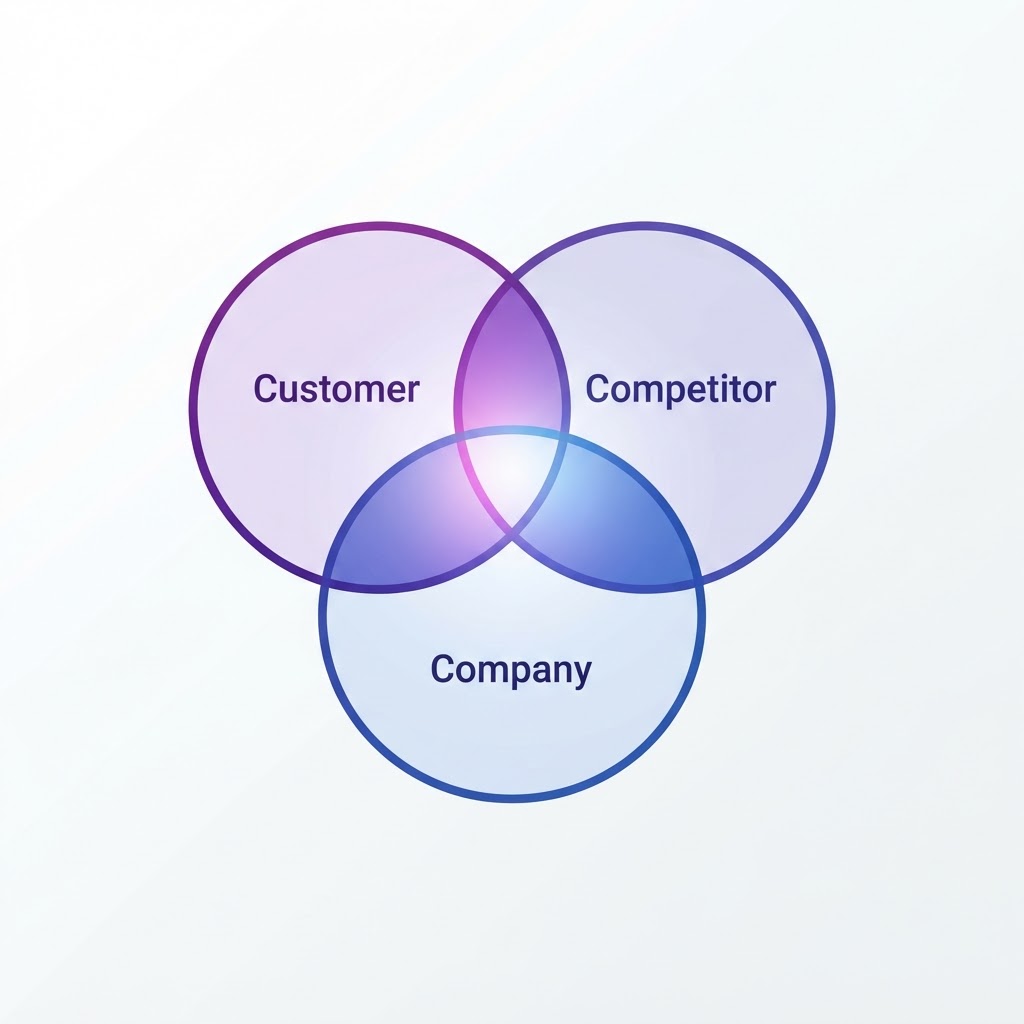
Sustainable strategy lives where customer, company, and competitor intersect.
Table of Contents
History & Origins
The 3C's model was developed by Kenichi Ohmae in his 1982 book 'The Mind of the Strategist.' Ohmae, a McKinsey consultant and corporate strategist, argued that sustainable strategy lives at the intersection of three forces: the customer, the company, and the competitors. The model was developed for Japanese industrial firms during their global expansion in the 1970s and 1980s but spread globally as a strategy framework. It remains influential in strategic planning, market-entry decisions, and competitive positioning across B2B and B2C companies. Ohmae's contribution was simplifying strategy to three forces that any business leader could assess without a complex model, making it particularly valuable for mid-market companies that don't have a dedicated corporate-strategy team. The framework emerged during a period when Japanese companies were outcompeting Western firms by focusing on customer needs rather than competitor moves, and Ohmae formalised that insight. The 3C's model is often used as the entry point to strategic analysis, followed by deeper frameworks (Five Forces for competitor, VRIO for company, customer-segmentation for customer) that expand each C. The framework's endurance comes from its completeness: any strategy that ignores one of the three C's is vulnerable, because a strong customer need with no company capability is a missed opportunity, a strong capability with no customer need is a vanity project, and a competitor gap with no customer demand is a trap.
Core Concept
The 3C's model argues that sustainable strategy requires aligning three forces: what customers want (customer), what you can deliver (company), and where competitors are weak (competitor). The strategy lives at the intersection of all three, in the 'defensible whitespace' where customer need, company capability, and competitor gap overlap. The model prevents two common failures: building capability no one wants (ignoring the customer) and chasing demand you can't serve (ignoring the company). The key is finding the intersection, not just one of the three. A strong customer need with no company capability is a missed opportunity; a strong capability with no customer need is a vanity project; a competitor gap with no customer demand is a trap. The framework also argues that the three C's are dynamic, not static: customer needs evolve, company capabilities grow or erode, and competitors move. The strategy must be re-assessed periodically to confirm the intersection still exists. The model is complementary to Porter's Five Forces (which deepens the competitor C) and to VRIO (which deepens the company C), and it pairs with customer-segmentation analysis (which deepens the customer C). The framework's power is in forcing the strategist to assess all three C's before committing, rather than fixating on one (usually the competitor) and ignoring the others. The 'defensible whitespace' is the sweet spot: a customer need that competitors aren't serving, that the company has (or can build) the capability to serve, and that is large enough to justify the investment.
B2B Application Guide
In B2B companies, the 3C's model finds defensible whitespace by mapping customer unmet needs, internal capability, and competitor gaps. A B2B distributor finds whitespace in omnichannel fulfilment by aligning customer demand for multi-channel delivery, in-house logistics capability, and competitor weakness in online ordering. The model shapes the assortment: customer demand defines what to stock, company capability defines what can be sourced profitably, and competitor positioning defines where margin is defensible. It also directs headcount toward the capability that creates the edge, rather than generic staffing that mirrors competitors. For technology selection, it steers build vs buy vs partner toward the whitespace, so engineering effort goes to capabilities that are rare and defensible while commodity needs are bought as SaaS. For supply chain, the 3C's shape the fulfilment model: customer demand defines the service promise, company capability defines the fulfilment architecture, and competitor positioning defines the differentiation. For merchandising, the 3C's shape the assortment strategy: customer demand defines the categories, company capability defines the sourcing depth, and competitor positioning defines the margin targets. For hiring, the 3C's direct talent toward the capability that creates the edge: if the whitespace is in data integration, hire data engineers; if it's in logistics, hire supply-chain talent; if it's in customer service, hire account managers. The framework also disciplines investment: a capability that serves a customer need but where competitors are strong is a me-too investment that won't differentiate; a capability that is rare but serves no customer need is a vanity project; only the intersection justifies disproportionate investment.
Step-by-Step Implementation
Step 1: Profile the customer. Map unmet needs, pain points, and willingness to pay using CRM data, interviews, and market research. Identify the top 3-5 unmet needs. Step 2: Assess company capability. Score the company's ability to serve each unmet need using VRIO or a simple capability audit. Identify where the company is strong, average, or weak. Step 3: Map competitor positioning. Score competitors on their ability to serve each unmet need. Identify where competitors are strong, average, or weak. Step 4: Find the intersection. For each unmet need, check all three C's: is there customer demand, company capability, and a competitor gap? The needs that pass all three are the defensible whitespace. Step 5: Prioritise the whitespace. Rank the whitespace opportunities by size, defensibility, and fit with the company's strategy. Step 6: Invest in the top opportunity. Direct opex, headcount, and technology toward the highest-ranked whitespace. Step 7: Monitor the three C's. Customer needs evolve, capabilities grow or erode, and competitors move. Re-assess each C quarterly to confirm the whitespace still exists. Step 8: Exit when the whitespace closes. If a competitor enters the whitespace or customer demand shifts, re-assess and redirect investment. Step 9: Document the map. Record the customer profile, capability assessment, and competitor map, so the strategy is defensible and the next planning cycle starts from evidence.
Common Pitfalls & How to Avoid Them
Pitfall 1: Fixating on the competitor. The strategy is designed to beat a competitor rather than serve a customer, producing a me-too offering. Avoid by starting with the customer and checking the competitor last. Pitfall 2: Ignoring company capability. The company chases a customer need it can't serve, producing a failed delivery. Avoid by assessing capability before committing. Pitfall 3: Treating the C's as static. The map is done once and never refreshed, and the whitespace closes without anyone noticing. Avoid by re-assessing quarterly. Pitfall 4: Not finding the intersection. The company invests in a need that has customer demand but no competitor gap, producing a me-too offering. Avoid by requiring all three C's to pass before investing. Pitfall 5: Over-investing in small whitespace. The whitespace is real but small, and the investment is disproportionate. Avoid by sizing the whitespace before investing. Pitfall 6: Not exiting when the whitespace closes. A competitor enters, and the company keeps investing in a now-crowded space. Avoid by monitoring and redirecting when the gap closes.
Extended Real-World Example
Cosmo Music, a B2B and B2C music distributor, used the 3C's to find whitespace in B2B omnichannel. Customer: B2B buyers wanted multi-channel ordering and fast fulfilment, with 68% citing online ordering as a top need. Company: Cosmo had strong in-house logistics (99% on-time), deep supplier relationships (120+ vendors), and a modern web platform. Competitor: major competitors were weak in online B2B ordering, with only 30% offering a self-service B2B portal. The intersection, defensible whitespace, was B2B omnichannel fulfilment. Investment was directed toward the B2B online ordering platform and fulfilment integration, capabilities that were rare and defensible, rather than me-too retail features competitors already had. The living map of customer need, company capability, and competitor position was refreshed each planning cycle, so investment was continuously re-pointed toward defensible whitespace and away from crowded categories. Over six quarters, the B2B online ordering platform was built and launched, with 3,200 B2B accounts onboarded in the first year. The platform offered self-service ordering, real-time inventory, and integrated fulfilment, capabilities that competitors couldn't match because they lacked the in-house logistics and supplier relationships. B2B revenue grew 34% in year one, and the B2B channel's margin was 8 points higher than the B2C channel, because the omnichannel fulfilment model was more efficient than the legacy B2B phone-and-fax process. The 3C's map was refreshed each quarter: customer demand was tracked through CRM data and interviews, company capability was scored through operational metrics, and competitor positioning was monitored through market research. In quarter 5, a competitor launched a B2B portal, but it lacked the fulfilment integration, and the gap persisted. In quarter 8, the map showed a new whitespace emerging: B2B buyers wanted integrated product data (specifications, images, compatibility), and competitors were weak in data quality. Cosmo invested in a product-data platform, extending the whitespace. The 3C's framework kept the strategy honest: investment went to the intersection of customer need, company capability, and competitor gap, not to me-too features or vanity projects. The result was a defensible B2B position that competitors couldn't easily replicate, because it was built on the intersection of all three C's, not just one.
Measuring Success
3C's success is measured by whether investment is going to the defensible whitespace and whether the whitespace is producing a defensible position. The key indicators are: whitespace revenue (the revenue from the intersection opportunities, which should be growing), competitor gap (the distance between the company's offering and the nearest competitor in the whitespace, which should be widening or holding), and investment alignment (the percentage of discretionary spend going to whitespace opportunities, which should be the majority). In practice, these are tracked on a quarterly map that shows the customer need, company capability, and competitor position for each whitespace opportunity. The ultimate test is whether the whitespace is producing a defensible market position: are customers choosing the company because of the whitespace offering, and is the margin higher than in non-whitespace categories? If the whitespace revenue is growing but the competitor gap is closing, the whitespace is being eroded, and the company needs to either deepen the capability or find new whitespace. If the investment is going to non-whitespace opportunities, the strategy has drifted, and the map needs to be re-assessed. The quarterly refresh of the three C's is the mechanism that keeps the strategy honest.
Framework Visualizations
Data-driven graphics showing how 3C's is applied to real B2B data.
Explore Further
Explore the Full Portfolio
This is the complete portfolio of Sufi Khan Sulaiman, a technology leader specialising in B2B commerce and digital automation. Start from the Home page for the overview, then move through two decades of career experience across FLIR Systems, Lorex Technology, and 1c Platform, and the full catalogue of project case studies spanning headless commerce migrations, AI recommendation engines, and multi-channel fulfilment systems.
The skills and certifications page maps the technical and leadership capabilities behind the work, while the articles and the knowledge base break down the thinking into actionable frameworks. For hands-on learning, the tutorials and applications sections cover practical builds from front-end fundamentals to full-stack web apps.
For consulting engagement, the expertise page outlines service offerings, the ecommerce hub covers platform architecture and automation strategy, and the ecommerce guide (PDF) is a downloadable 55-page field manual. When you are ready to talk, the contact page is the direct line.