PESTLE
Scan six macro forces before they become expensive platform retrofits.
Table of Contents
History & Origins
PESTLE originated as ETPS in 1967 by Francis Aguilar at Harvard Business School, who published it in his book 'Scanning the Business Environment.' The original four forces (Economic, Technical, Political, Social) were later expanded to PESTLE by adding Legal and Environmental. The framework became a standard tool in strategic planning, horizon scanning, and market-entry analysis, used by corporate strategy teams, consultants, and business schools worldwide. It is particularly valuable for long-range planning and geographic expansion decisions, where external forces that are outside the company's control can reshape the business model if they are not anticipated. PESTLE is often paired with Porter's Five Forces and SWOT to create a complete external-internal strategic picture: PESTLE scans the macro environment, Five Forces assesses the industry, and SWOT synthesises both into an internal-external picture. The framework emerged during a period of increasing environmental turbulence in the late 1960s, when companies realised that external forces (oil shocks, regulatory changes, social movements) could disrupt business models that had been stable for decades. Aguilar's contribution was systematising the scan across a defined set of forces, so companies wouldn't miss a force because they weren't looking for it. Today, PESTLE is used in annual strategic planning, in market-entry decisions, and in risk management, where it serves as the external complement to internal capability assessments.
Core Concept
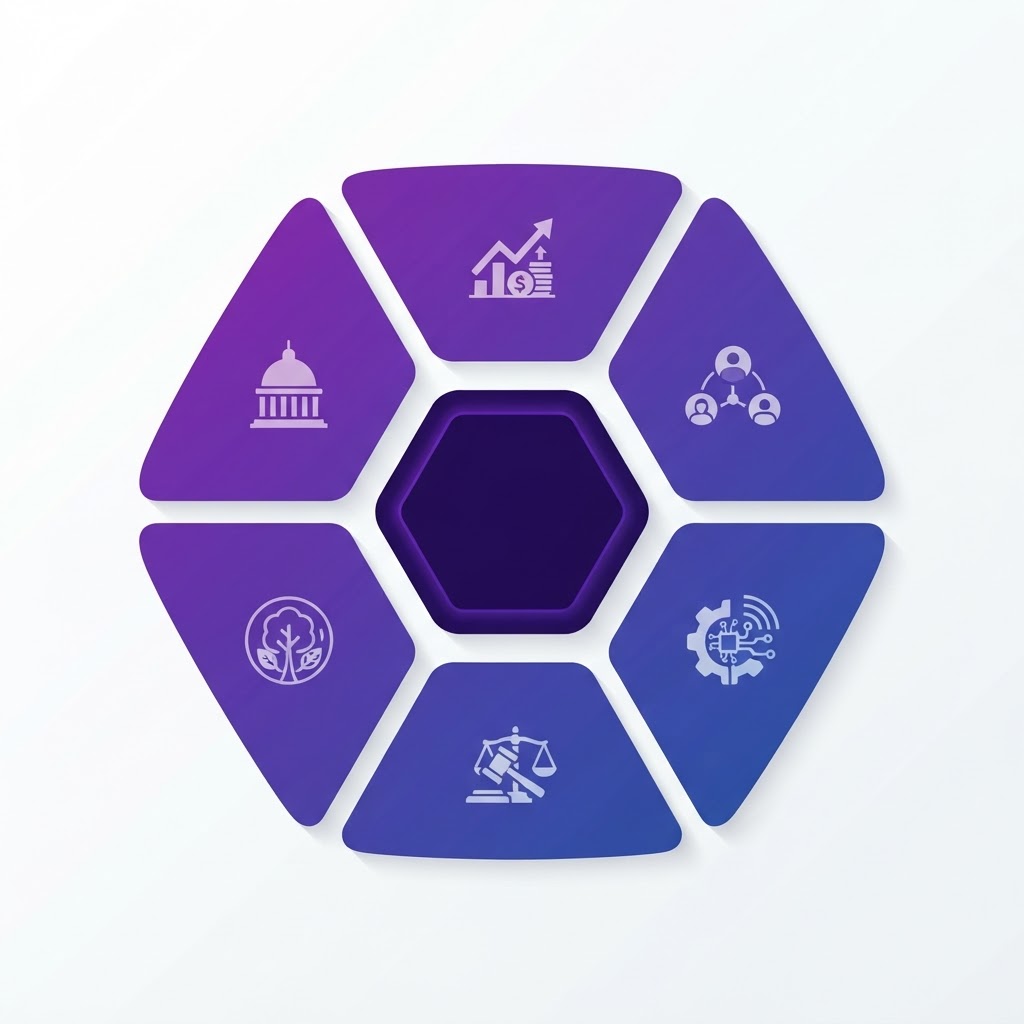
PESTLE audits the macro environment across six forces: Political, Economic, Social, Technological, Legal, and Environmental. It surfaces external risks and opportunities outside the company's control but inside its planning horizon. The framework is not about predicting the future but about identifying shifts that would affect the platform, the roadmap, or the business model if they occurred. Each force is assessed for current state and near-term shift, then translated into a roadmap risk or bet. The framework is complementary to internal analysis tools (SWOT, VRIO): PESTLE scans the external environment, while the internal tools assess the company's ability to respond to what PESTLE surfaces. The six forces are deliberately broad, so the scan doesn't miss a category, but each force is then drilled into specific shifts that matter for the business. The framework also distinguishes between a trend (a directional shift that is already underway) and an uncertainty (a shift that may or may not occur). Trends are translated into roadmap bets; uncertainties are translated into contingency plans. The key discipline is to assess each force with evidence, not speculation, and to translate each finding into a concrete action (a roadmap item, a risk mitigation, a contingency plan), rather than leaving it as a general observation. PESTLE is also recursive: each force can be drilled into sub-forces (e.g., Economic splits into interest rates, inflation, currency, employment), so the scan is as granular as the business needs.
B2B Application Guide
In B2B companies, PESTLE scans for regulatory, economic, and technology shifts before they hit the platform. Interest rates reshape financing and inventory carrying costs. Regulations like GDPR or PIPEDA reshape data architecture and compliance opex. Social shifts reshape channel mix. Technology shifts (AI-native, mobile-first) reshape the dev roadmap. The framework flags coming constraints that would otherwise become expensive retrofits, and it prioritises tech-debt work that de-risks compliance before it's mandated. It also anticipates skill shifts (AI engineering, privacy roles) so the talent pipeline evolves ahead of demand. For supply chain, PESTLE surfaces supplier-country political risk, currency exposure on imported components, and environmental standards that change packaging and sourcing. For merchandising, PESTLE surfaces social shifts (sustainability, local sourcing) that reshape the assortment and the supplier mix. For technology selection, PESTLE surfaces technology shifts (cloud-native, AI, edge) that shape the platform roadmap and the build-vs-buy decision. For hiring, PESTLE surfaces skill shifts (AI engineering, privacy roles, sustainability reporting) so the talent pipeline evolves ahead of demand. For vendor management, PESTLE surfaces legal shifts (data residency, AI regulation) that reshape vendor contracts and governance. The framework also disciplines risk management: each force is assessed for likelihood and impact, and the high-impact, high-likelihood shifts are translated into roadmap actions, while the high-impact, low-likelihood shifts are translated into contingency plans.
Step-by-Step Implementation
Step 1: Assemble the scan team. Include strategy, operations, technology, legal, and supply-chain representatives, so each force is assessed by someone with domain knowledge. Step 2: Scan each force. For each of the six forces, identify the current state and the near-term shifts (12-24 months). Use evidence: regulatory filings, economic data, technology analyst reports, social trend data. Step 3: Rate each shift. Score each shift on likelihood (1-5) and impact (1-5). The product is the risk/bet score. Step 4: Translate shifts into actions. For each high-score shift, define a concrete action: a roadmap item (for a trend), a risk mitigation (for a high-likelihood risk), or a contingency plan (for an uncertainty). Step 5: Assign owners. Each action gets an owner accountable for tracking and executing it. Step 6: Set a review cadence. Re-scan quarterly, because forces shift. The scan is a living document, not a one-time exercise. Step 7: Integrate with planning. Feed the PESTLE actions into the annual planning cycle, so the roadmap reflects the external environment. Step 8: Monitor leading indicators. For each shift, identify a leading indicator that signals the shift is accelerating, so the company can act early. Step 9: Document the scan. Record the forces, shifts, scores, and actions, so the scan is defensible and the next cycle starts from evidence.
Common Pitfalls & How to Avoid Them
Pitfall 1: Treating PESTLE as a one-time exercise. The scan is done once and never refreshed, and shifts are missed. Avoid by setting a quarterly re-scan cadence. Pitfall 2: Listing forces without translating to actions. The scan produces a list of observations but no roadmap items, so nothing changes. Avoid by requiring a concrete action for each high-score shift. Pitfall 3: Assessing with speculation, not evidence. Each force is assessed with opinion rather than data, producing a scan that doesn't survive scrutiny. Avoid by requiring evidence for each shift. Pitfall 4: Missing a force. The scan covers five forces and misses the sixth, leaving a blind spot. Avoid by using the six-force checklist to ensure completeness. Pitfall 5: Not assigning owners. Actions are defined but no one is accountable, so they don't happen. Avoid by assigning an owner to each action. Pitfall 6: Not integrating with planning. The scan is done but not fed into the roadmap, so the platform doesn't reflect the external environment. Avoid by integrating the scan with the annual planning cycle.
Extended Real-World Example
Before a European expansion, a PESTLE scan flagged GDPR (Legal) as a high-impact force requiring data-residency architecture. Economic (rising interest rates) was flagged as a risk to inventory carrying costs. Technological (AI regulation pending) was flagged as a future constraint on the recommendation engine. The scan shaped the roadmap: data-residency was built before launch, inventory safety stock was reduced to offset carrying costs, and the recommendation engine was designed with AI-governance guardrails before regulation arrived. The standing horizon-scan cadence with named owners for each force ensured that regulatory, economic, and technology shifts were logged, rated, and translated into roadmap actions before they became expensive retrofits that inflate opex and tech debt. Over the 12-month expansion preparation, the PESTLE scan produced 14 high-score shifts across the six forces. Political: EU data-localisation requirements (score 20) led to a data-residency architecture built before launch. Economic: interest rates rising (score 15) led to a 12% reduction in safety stock to offset carrying costs. Social: B2B buyers preferring self-service (score 16) led to a self-service portal built into the expansion. Technological: AI regulation pending (score 12) led to AI-governance guardrails in the recommendation engine. Legal: GDPR fines up to 4% of revenue (score 25) led to a compliance program with a dedicated privacy officer. Environmental: packaging regulations in Germany (score 10) led to a packaging redesign. Each shift had an owner, a roadmap item, and a leading indicator. The GDPR action (data-residency) was the highest-score shift, and it was built before launch, avoiding a potential 4% fine that would have exceeded the expansion's first-year profit. The interest-rate action (safety-stock reduction) saved $340K in carrying costs, offsetting the higher financing rates. The AI-regulation action (governance guardrails) was built before the EU AI Act took effect, avoiding a retrofit that would have cost 3x more after launch. The scan was refreshed quarterly: in quarter 3, a new political shift (export controls on certain components) was flagged and translated into a dual-sourcing action. In quarter 6, a new social shift (sustainability reporting requirements from B2B customers) was flagged and translated into a sustainability-data action. The PESTLE scan kept the expansion ahead of the external environment, so the platform was built for the forces that would shape it, not for the forces that were already past.
Measuring Success
PESTLE success is measured by whether external shifts are translated into roadmap actions before they become expensive retrofits. The key indicators are: scan completeness (all six forces are assessed each cycle), action conversion rate (the percentage of high-score shifts that have a defined action and owner), and leading-indicator coverage (the percentage of high-score shifts with a monitored leading indicator). In practice, these are tracked by the scan document, which should show each force, its shifts, scores, actions, and owners. The ultimate test is whether the company is ahead of the external environment: are regulatory, economic, and technology shifts being built into the platform before they're mandated, or are they being retrofitted after they hit? If the company is consistently retrofitting, the scan is either not being done or not being integrated with planning. A successful PESTLE practice produces a roadmap that reflects the external environment, with each major platform decision traceable to a PESTLE shift, and each high-score shift having a monitored leading indicator that triggers early action.
Framework Visualizations
Data-driven graphics showing how PESTLE is applied to real B2B data.
Explore Further
Explore the Full Portfolio
This is the complete portfolio of Sufi Khan Sulaiman, a technology leader specialising in B2B commerce and digital automation. Start from the Home page for the overview, then move through two decades of career experience across FLIR Systems, Lorex Technology, and 1c Platform, and the full catalogue of project case studies spanning headless commerce migrations, AI recommendation engines, and multi-channel fulfilment systems.
The skills and certifications page maps the technical and leadership capabilities behind the work, while the articles and the knowledge base break down the thinking into actionable frameworks. For hands-on learning, the tutorials and applications sections cover practical builds from front-end fundamentals to full-stack web apps.
For consulting engagement, the expertise page outlines service offerings, the ecommerce hub covers platform architecture and automation strategy, and the ecommerce guide (PDF) is a downloadable 55-page field manual. When you are ready to talk, the contact page is the direct line.