
Global 3PL Network & Cross-Border Warehousing
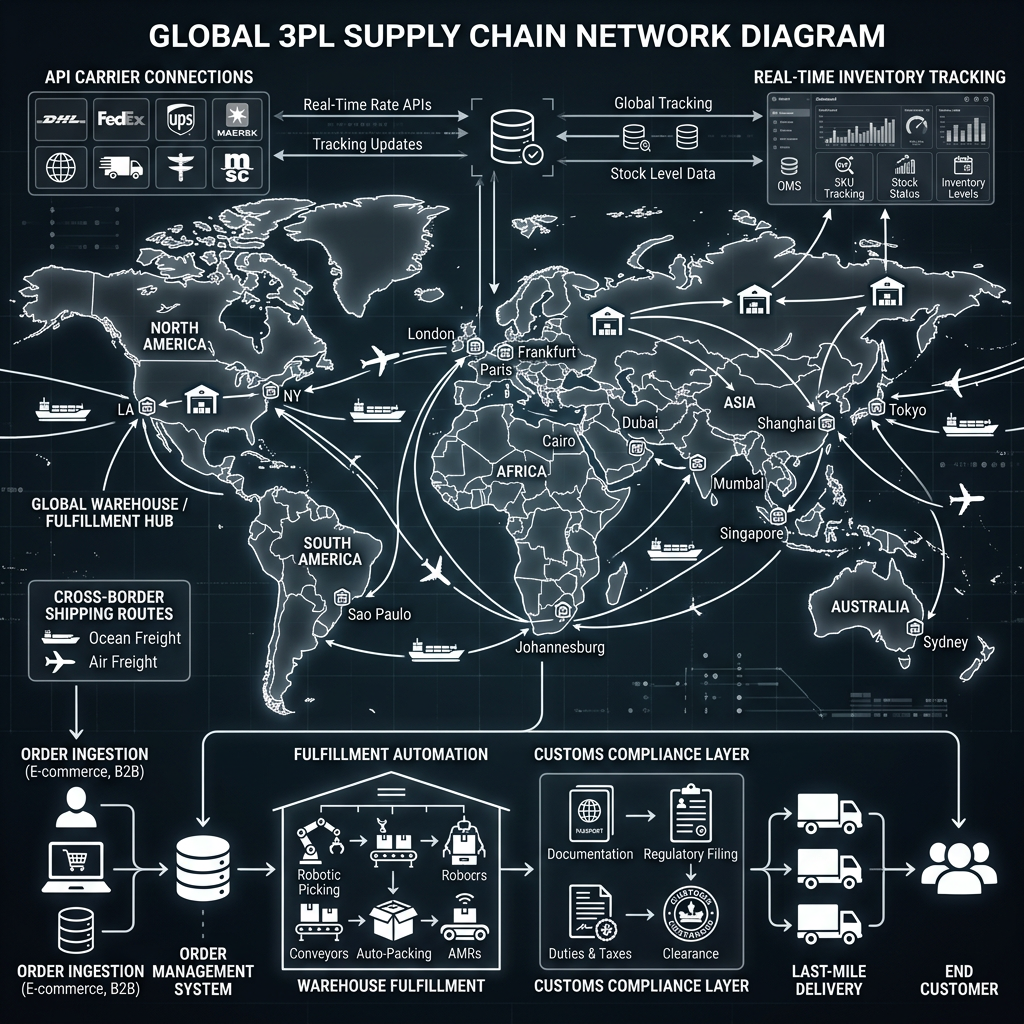
Centralized 3PL integration platform with API-based partner connectivity, cross-border warehousing, dynamic inventory positioning, customs compliance, and advanced fulfillment automation.
Multi-region 3PL network
Scope
API + modernized EDI
Integration
End-to-end fulfillment pipeline
Automation
Multi-country customs + duties
Compliance
Built a unified platform orchestrating logistics across multiple regions, partners, and fulfillment models. Replaced fragmented systems and manual processes with API-based connectivity, automated data exchange, and unified tracking superseding legacy EDI-only workflow automation patterns.
Developed a cross-border warehousing system supporting multi-country inventory positioning, duty/tax optimization, and region-specific fulfillment rules. Dynamic inventory allocation placed products closer to customers. Customs compliance and data governance covered documentation requirements and international shipping standards. Automated receiving, picking, packing, and shipping workflow automation patterns included automated carrier selection, real-time inventory synchronization, and exception handling. Dashboards provided real-time insight into inventory levels, order status, carrier performance, and warehouse throughput.
The hardest technical challenge was real-time inventory synchronization across 15 fulfillment centers spanning 7 time zones. Legacy systems batch-updated overnight - causing daily overselling incidents and customer frustration. We moved to event-driven architecture design inventory management: every warehouse action (pick, receipt, damage) published an event immediately. A central inventory service consumed these events and updated availability in under 2 seconds globally. The impact was immediate - overselling incidents dropped to near zero.
International duty and tax calculation was deceptively complex. Over 180 countries have different rules - HS codes, tariff rates, VAT, de minimis thresholds, and restricted product lists. We built a rules engine integrating with customs data providers that calculated total landed cost at checkout, eliminating surprises at delivery. This feature alone increased international conversion rate optimisation rates by 12% because customers saw honest pricing upfront.
Carrier optimization generated the largest cost savings. The algorithm evaluated 15+ carriers per order comparing cost, estimated delivery time, reliability score, and dimensional weight rules. We discovered that switching 30% of orders from default carriers to lower-cost alternatives with equivalent reliability saved $2.1M annually with zero customer-visible impact. Real-time carrier performance scoring meant we automatically shifted volume away from carriers experiencing delays.
Architecture Diagrams
Ecommerce Architecture & Strategy
Explore the Full Portfolio
This is the complete portfolio of Sufi Khan Sulaiman, a technology leader specialising in B2B commerce and digital automation. Start from the Home page for the overview, then move through two decades of career experience across FLIR Systems, Lorex Technology, and 1c Platform, and the full catalogue of project case studies spanning headless commerce migrations, AI recommendation engines, and multi-channel fulfilment systems.
The skills and certifications page maps the technical and leadership capabilities behind the work, while the articles and the knowledge base break down the thinking into actionable frameworks. For hands-on learning, the tutorials and applications sections cover practical builds from front-end fundamentals to full-stack web apps.
For consulting engagement, the expertise page outlines service offerings, the ecommerce hub covers platform architecture and automation strategy, and the ecommerce guide (PDF) is a downloadable 55-page field manual. When you are ready to talk, the contact page is the direct line.