SWOT
Synthesise findings into strengths, weaknesses, opportunities, and threats.
Table of Contents
History & Origins
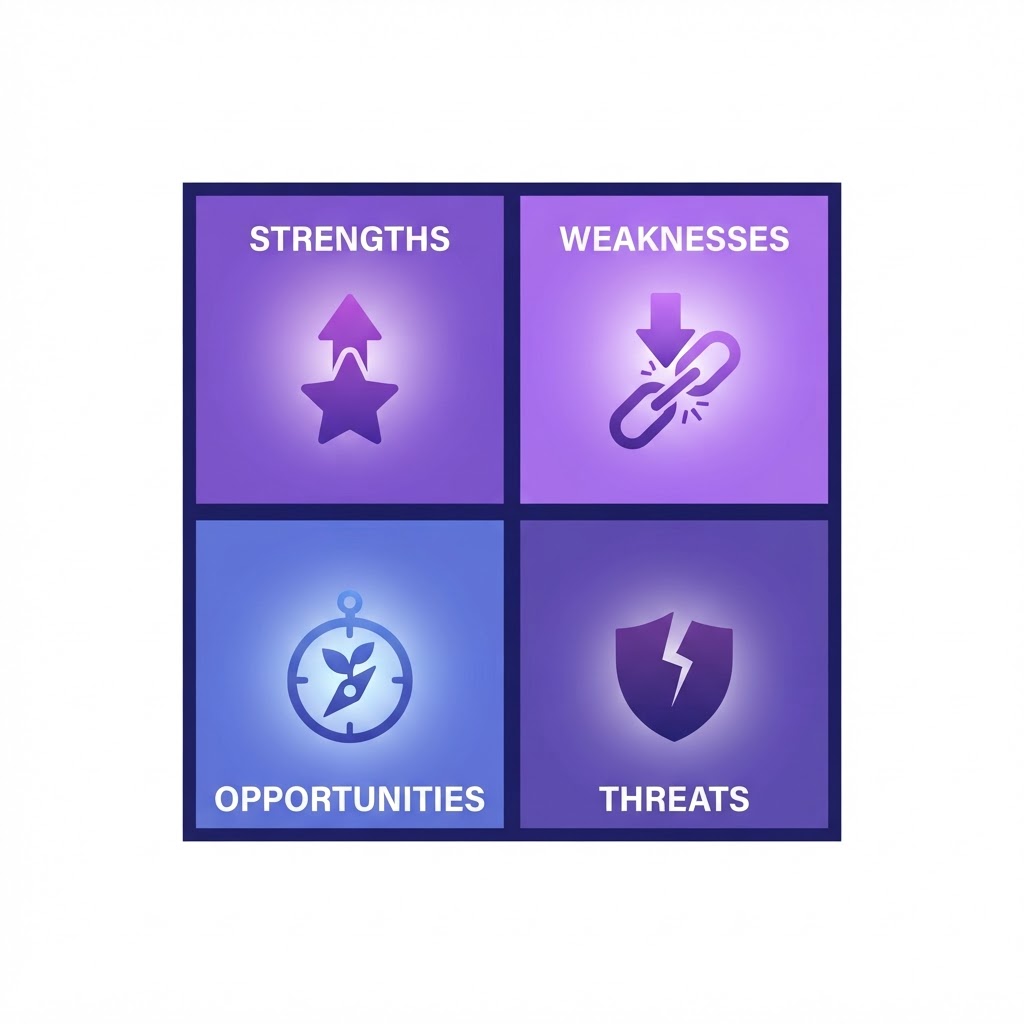
SWOT was developed by Albert Humphrey at the Stanford Research Institute (SRI) in the 1960s during a study of corporate planning failures at Fortune 500 companies. Humphrey's team found that companies failed not because they lacked data but because they couldn't synthesise it into a coherent picture. SWOT (Strengths, Weaknesses, Opportunities, Threats) was created as a synthesis tool to consolidate findings from multiple analyses into a single, honest picture. The framework became one of the most widely used strategy tools in business, taught in every MBA program and used in every strategic planning cycle from startups to enterprises. SWOT is typically the final synthesis step after analytical frameworks (Five Forces, PESTLE, VRIO) have done their work. Humphrey developed SWOT during a period when corporate planning was producing thick reports that no one acted on, because the data was too voluminous to synthesise. His contribution was distilling the data into four quadrants that any leader could scan in minutes, with each quadrant tied to a concrete action. The framework's endurance comes from its simplicity: four quadrants, two internal (Strengths, Weaknesses) and two external (Opportunities, Threats), that create a complete picture of the company's strategic position. Today, SWOT is used in annual strategic planning, in market-entry decisions, and in competitive assessments, often as the summary slide that synthesises the deeper analysis into a single, actionable picture.
Core Concept
SWOT summarises internal Strengths and Weaknesses against external Opportunities and Threats to ground strategy in an honest, evidence-based picture. Strengths are leveraged, weaknesses become a fix plan, opportunities direct investment, and threats shape defensive priorities. SWOT is the synthesis step after the analytical frameworks have done their work. It converts findings into prioritised actions, so strategy responds to the actual situation rather than an aspirational one. The framework's power is its simplicity: four quadrants that any team can fill, making it accessible from the boardroom to the sprint review. The key discipline is that each entry must be evidence-based, not aspirational, so the picture is honest rather than flattering. The framework also distinguishes between internal factors (Strengths, Weaknesses, which the company can control) and external factors (Opportunities, Threats, which the company can't control but must respond to). The key insight is that a Strength is only a Strength if it's both internal and superior to competitors; a capability that's internal but parity is not a Strength, it's table-stakes. Similarly, an Opportunity is only an Opportunity if the company has the Strengths to capture it; an opportunity without the capability to pursue it is a wish, not a strategy. The framework also argues that the most valuable SWOT entries are the intersections: a Strength that aligns with an Opportunity is a strategic bet; a Weakness that aligns with a Threat is a strategic risk.
B2B Application Guide
In B2B companies, SWOT consolidates CRM, ERP, and web findings into a single picture. A strength (modern headless stack) is leveraged by scaling traffic. A weakness (QA gap) becomes a funded initiative to automate testing. An opportunity (AI personalisation) becomes a pilot. A threat (new entrant) drives diversification. The framework pairs internal capability against external reality, so opex, resourcing, and technology plans respond to the actual situation rather than a vendor pitch that adds integration tech debt without addressing a real weakness. For hiring, SWOT turns the honest picture into a staffing plan: a strength in automation is scaled with the right talent, a weakness in test coverage becomes a funded hire, an opportunity in AI becomes a pilot team. For supply chain, SWOT synthesises the logistics audit: a strength in warehouse locations is leveraged, a weakness in supplier diversity is fixed, an opportunity in nearshoring is explored, a threat in tariff policy is hedged. For merchandising, SWOT synthesises the assortment audit: a strength in private label is scaled, a weakness in data quality is fixed, an opportunity in a new category is explored, a threat from a competitor's exclusive is hedged. For technology selection, SWOT synthesises the platform audit: a strength in the headless stack is leveraged, a weakness in the legacy CRM is fixed, an opportunity in AI personalisation is piloted, a threat from a new entrant's platform is hedged. For vendor management, SWOT synthesises the vendor audit: a strength in strategic supplier relationships is leveraged, a weakness in vendor governance is fixed, an opportunity in vendor consolidation is explored, a threat from supplier concentration is hedged.
Step-by-Step Implementation
Step 1: Gather evidence. Collect data from CRM, ERP, web analytics, customer interviews, and competitor research. Don't start the SWOT without evidence. Step 2: List Strengths. Identify internal capabilities that are superior to competitors, with evidence. A capability that's parity is not a Strength. Step 3: List Weaknesses. Identify internal gaps that put the company at a disadvantage, with evidence. Be honest; a flattering SWOT is useless. Step 4: List Opportunities. Identify external shifts the company could exploit, with evidence. An opportunity without the capability to pursue it is a wish. Step 5: List Threats. Identify external shifts that could harm the company, with evidence. Step 6: Find the intersections. Identify where a Strength aligns with an Opportunity (a strategic bet) and where a Weakness aligns with a Threat (a strategic risk). Step 7: Convert to actions. Each Strength becomes a leverage action, each Weakness becomes a fix plan, each Opportunity becomes an investment, each Threat becomes a defense. Step 8: Prioritise. Rank the actions by impact and feasibility. Step 9: Refresh each planning cycle. Re-do the SWOT with fresh evidence each year, so the picture stays current.
Common Pitfalls & How to Avoid Them
Pitfall 1: Aspirational entries. The SWOT lists what the company wishes were true, not what the evidence supports. Avoid by requiring evidence for each entry. Pitfall 2: Listing parity as Strength. A capability that's internal but not superior to competitors is table-stakes, not a Strength. Avoid by comparing to competitors before classifying. Pitfall 3: Not finding the intersections. The SWOT lists the four quadrants but doesn't identify where Strengths align with Opportunities or Weaknesses align with Threats. Avoid by explicitly finding the intersections. Pitfall 4: Not converting to actions. The SWOT is a list, not a plan, and nothing changes. Avoid by converting each entry to a concrete action. Pitfall 5: Not refreshing. The SWOT is done once and the picture goes stale. Avoid by re-doing the SWOT each planning cycle. Pitfall 6: Being too flattering. The Weaknesses are soft-pedalled to avoid uncomfortable truths. Avoid by being honest; a flattering SWOT is useless.
Extended Real-World Example
A B2B ecommerce company synthesised a stack audit into SWOT. Strengths: modern headless commerce stack, strong supplier relationships. Weaknesses: legacy CRM, QA gap, stale BOM data. Opportunities: AI personalisation, new B2B market. Threats: new entrant with lower prices, margin pressure. The SWOT became an action plan: leverage the headless stack (scale traffic), fix the QA gap (fund test automation), pilot AI personalisation (three-month experiment), and hedge the entrant threat (build lock-in via ERP integrations). Strategy responded to the actual situation, not an aspirational one. The SWOT was refreshed each planning cycle from live data and team input, so the honest picture evolved with reality. Over four quarters, the SWOT-driven action plan produced measurable results. Strengths leveraged: the headless stack was scaled to handle 3x traffic (from 200K to 600K monthly sessions), and the strong supplier relationships were leveraged to negotiate 4% better terms on the top 50 SKUs. Weaknesses fixed: the legacy CRM was replaced with a modern CDP (customer data platform), the QA gap was closed with a test-automation initiative (test coverage rose from 35% to 78%, change-failure rate dropped from 18% to 7%), and the stale BOM data was refreshed (98% of BOMs updated within 6 months). Opportunities pursued: the AI personalisation pilot was run in quarter 2 (3-month experiment on the top 1,000 customers), producing a 12% AOV lift, and was scaled in quarter 3. The new B2B market was entered in quarter 3 (2 new B2B segments, contributing 8% of revenue by quarter 4). Threats hedged: the new entrant's low-price strategy was countered with lock-in (14 ERP connectors built, making switching costly), and the margin pressure was offset by the supplier-terms improvement and the AOV lift. The intersections were the most valuable: the Strength (headless stack) aligned with the Opportunity (AI personalisation) became a strategic bet (the personalisation engine was built on the headless stack, producing the 12% AOV lift). The Weakness (QA gap) aligned with the Threat (new entrant with faster releases) became a strategic risk (the QA gap was slowing releases while the entrant was shipping faster), which was addressed by the test-automation initiative. The SWOT was refreshed each quarter: in quarter 3, a new Strength emerged (the CDP investment produced a data advantage), a new Weakness emerged (the personalisation engine required ML talent that was scarce), a new Opportunity emerged (the B2B market showed demand for integrated product data), and a new Threat emerged (a competitor acquired a personalisation vendor). The refreshed SWOT redirected investment: the data advantage was leveraged (the personalisation engine was extended), the ML-talent gap was fixed (2 ML engineers were hired), the product-data opportunity was pursued (a product-data platform was built), and the competitor's acquisition was hedged (the proprietary data was hardened). The SWOT kept the strategy honest: investment went to the intersections of Strengths and Opportunities, and risks were addressed at the intersections of Weaknesses and Threats.
Measuring Success
SWOT success is measured by whether the SWOT entries are evidence-based and whether the actions are being executed. The key indicators are: evidence coverage (the percentage of SWOT entries with supporting evidence, which should be 100%), action conversion rate (the percentage of SWOT entries that have a defined action and owner, which should be high), and intersection identification (whether the Strength-Opportunity and Weakness-Threat intersections were identified, which should be yes). In practice, these are tracked by the SWOT document and the action plan it produces. The ultimate test is whether the SWOT is producing a strategy that responds to the actual situation: are the Strengths being leveraged, the Weaknesses being fixed, the Opportunities being pursued, and the Threats being hedged? If the SWOT is done but the actions aren't executed, the framework is an academic exercise. If the entries are aspirational rather than evidence-based, the strategy is built on wishes, not reality. A healthy SWOT practice produces an evidence-based picture with 100% evidence coverage, a high action conversion rate, identified intersections, and a quarterly refresh that keeps the picture current.
Framework Visualizations
Data-driven graphics showing how SWOT is applied to real B2B data.
Explore Further
Explore the Full Portfolio
This is the complete portfolio of Sufi Khan Sulaiman, a technology leader specialising in B2B commerce and digital automation. Start from the Home page for the overview, then move through two decades of career experience across FLIR Systems, Lorex Technology, and 1c Platform, and the full catalogue of project case studies spanning headless commerce migrations, AI recommendation engines, and multi-channel fulfilment systems.
The skills and certifications page maps the technical and leadership capabilities behind the work, while the articles and the knowledge base break down the thinking into actionable frameworks. For hands-on learning, the tutorials and applications sections cover practical builds from front-end fundamentals to full-stack web apps.
For consulting engagement, the expertise page outlines service offerings, the ecommerce hub covers platform architecture and automation strategy, and the ecommerce guide (PDF) is a downloadable 55-page field manual. When you are ready to talk, the contact page is the direct line.